
Grandfather by Derek Mahon analysis
Grandfather by Derek Mahon analysis: Context
English Hub Plus
You have the notes on Grandfather. Now write the answer.
See H1 sample answers on Derek Mahon, marked against PCLM, then get your own essay corrected against the SEC marking scheme. Read everything on Plus free for 7 days and try one AI tool. No card. Then €4.99 a month.
Start your free trialEvery note on this site stays free.
Derek Mahon’s Grandfather is a reflection on the speaker’s grandfather, capturing his personality and the speaker’s experience of his presence. The poem portrays the grandfather as a complex figure, both humorous and resilient, with a deep connection to his past. Mahon weaves together elements of nostalgia, loss, and admiration as he presents the grandfather’s routines, quirks, and his mysterious nature. Through vivid, concise imagery and tone, the poem explores themes of memory, generational differences, and the inevitability of time. The grandfather is depicted as someone who lives on his own terms, escaping both the present and the future while maintaining a strong link to his personal history.
Stanza by Stanza Analysis
The return (lines 1-2)
The poem begins with Mahon’s image of the grandfather being brought home “on a stretcher from the world, / wounded but humorous” (l. 1-2), suggesting that he has been through a great deal in his life and is now removed from its active business, perhaps by old age or illness. The pairing of “wounded” with “humorous” in the same breath does most of the work here: it establishes at once that he has suffered and that suffering has not touched his character. The quick recovery that follows introduces the idea that the grandfather, though weakened, is not defeated by his circumstances.
The past made present (lines 3-5)
Mahon suggests that the grandfather’s memories are deeply embedded in his past, particularly his childhood. Rows of industrial gantries are described rolling away like a stage set to reveal an earlier landscape underneath, suggesting a working life spent among boiler-rooms and machinery that has, underneath it, an older and more private world. That world belongs to the grandfather alone: nobody else can reach it, and the poem is careful to mark it as strictly personal territory, inaccessible even to the people who love him.
Restless mornings (lines 6-8)
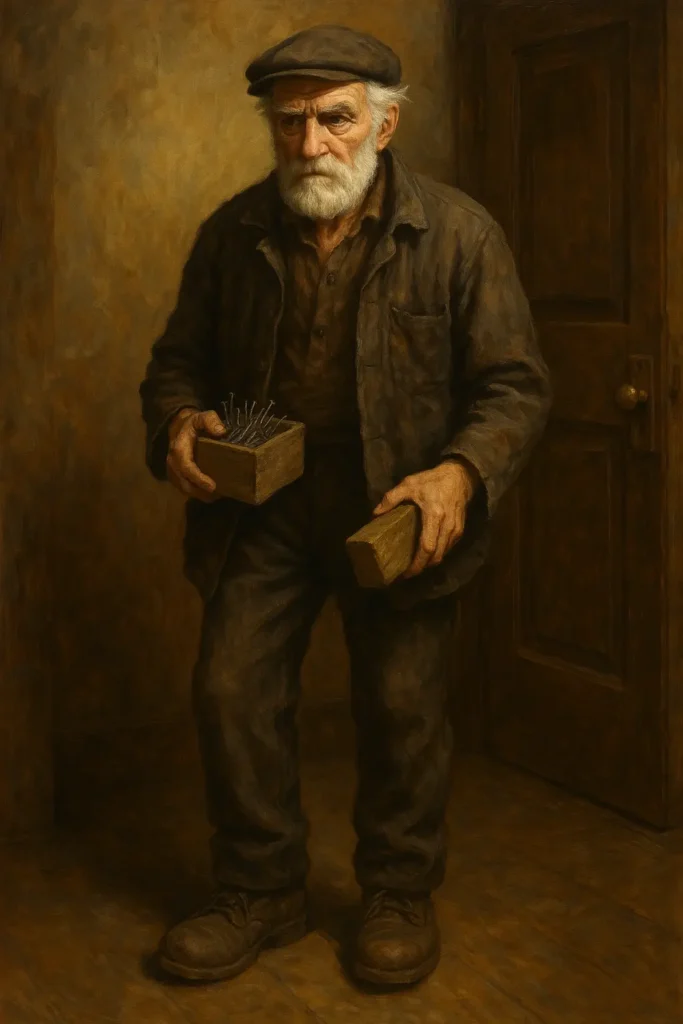
These lines describe the grandfather’s restless energy and his habit of getting up early, even on cold mornings, occupying his time with small handiwork – a block of wood, a box of nails – that keeps him discreetly, harmlessly busy. The stanza closes on a simile that catches his whole manner in one line: he goes “banging round the house like a four-year-old –” (l. 8), noisy, unpredictable, impossible to keep track of. It is an affectionate comparison, but it also plants the idea, developed in the next stanza, that he is never quite where you expect him to be.
Elusiveness after dark (lines 9-11)
Never there when called during the day, the grandfather becomes more perceptible after dark: his boots are heard thumping through the hall long before he is seen, a strange reversal in which his presence grows more solid the later the hour gets. There is real fondness in the description of him as “cute” in his own sly way, but also a quiet acknowledgment that he is often more heard than truly known.
The nightly ritual (lines 12-14)
The poem’s ending gives the grandfather a small, private ceremony: each night, Mahon writes, “his shrewd eyes bolt the door and wind the clock / against the future,” (l. 12-13), an image of a man trying to secure his house and hold back time in the same practised gesture. The choice of “wind” rather than any looser verb matters – it is a deliberate, mechanical act of control, repeated nightly, as if enough winding could keep the future from arriving on schedule. The poem’s famous last line then turns the whole portrait on its head: “Nothing escapes him; he escapes us all.” (l. 14). The grandfather notices everything, and yet remains, to the very end, the one person in the poem nobody can fully catch.
Key Themes
Memory and the past
The poem reflects on the grandfather’s strong connection to his past, particularly his childhood. His memories are unique to him, and while others may see him as a part of the present, his inner world is shaped by his past experiences. The childhood landscape discussed above is something only he can access, and his small daily projects with wood and nails seem to connect him to that earlier life.
Elusiveness and mystery
The grandfather is portrayed as a figure who is hard to reach, both physically and emotionally. He is often described as not being there when called and is compared to a restless child. Despite his presence in the household, there is an emotional distance, and the closing line underscores the idea that he ultimately escapes others’ understanding even as nothing escapes his own notice.
Resistance to time and mortality
The grandfather’s nightly ritual of bolting the door and winding the clock, discussed above, suggests his resistance to the passage of time and the changes it brings. That small, repeated act implies an awareness of his own mortality and a desire to hold onto the present moment, even as time inevitably moves forward.
Mood of the Poem
The mood of Grandfather is one of quiet reflection, admiration, and a sense of melancholy. Mahon captures the grandfather’s personality with humour and warmth, but there is also an undercurrent of sadness as the poem acknowledges the inevitable passage of time and the distance between generations. The mood is a blend of nostalgia, affection, and a recognition of the mystery that surrounds the grandfather’s life and character.
Literary Devices
Metaphor
The opening image of the grandfather being brought home like a casualty from the world suggests his detachment from its active business, as if he has been brought back from a place of exhaustion or suffering.
Alliteration
The repeated r sounds running through the description of the boiler-rooms and gantries create a rhythmic quality that mirrors the industrial setting being described.
Simile
Comparing the grandfather’s restlessness to that of a young child, in the line quoted above, highlights his energy and unpredictability.
Irony
The poem’s closing line has an ironic twist: it emphasises the grandfather’s perceptive nature, yet his own inner life remains a mystery to those around him.
Conclusion
Derek Mahon’s Grandfather is a poignant reflection on the life of a grandfather who is both physically present and emotionally elusive. Through vivid imagery and affectionate descriptions, Mahon captures the complexity of the grandfather’s character, his resilience, humour, and connection to the past, as well as his restlessness and distance from others. The poem explores themes of memory, time, and the inevitability of mortality, ultimately presenting the grandfather as a figure who escapes full understanding, even as he continues to observe the world around him with sharp, shrewd eyes.

English Hub Plus
The notes got you this far. The writing is next.
H1 sample answers on Derek Mahon, marked against PCLM, plus quizzes and essay corrections against the SEC marking scheme. 7 days free, no card, then €4.99 a month.